
Same Day, Opposite § 101 Results for AI Inventions: Why Storytelling Still Matters in 2026

It is essentially impossible to run a controlled experiment in patent law; that is, to minimize the influence of factors other than those you want to examine. On August 31, 2026, though, the PTAB got about as close as it could to A/B testing claims directed to AI inventions:
✅ Two panels in TC 2100.
✅ Two independent claims directed to neural networks.
✅ One panel (2-1) found the claims eligible.
❌ One panel (3-0) found them ineligible.
The difference between the two is in how each applicant told its story, technically speaking, and how that story intersects with the PTAB’s framework in Ex parte Desjardins and the Federal Circuit’s in Recentive Analytics.
Desjardins on one side, Recentive on the other
Every practitioner drafting claims directed to AI systems should be familiar with Ex parte Desjardins and Recentive Analytics. Desjardins is applicant’s shield in prosecution, and Recentive is the accused infringer’s sword in litigation.
In Ex parte Desjardins, Appeal No. 2024-000567 (PTAB Sept. 26, 2025) (designated precedential),¹ a review panel composed of Director Squires (sitting alongside Acting Commissioner for Patents Wallace and Vice Chief Administrative Patent Judge Kim) determined that claims to training ML models across multiple tasks while preserving prior tasks were patent eligible under MPEP § 2106, which incorporates the USPTO’s “2019 Revised Patent Subject Matter Eligibility Guidance,” 84 Fed. Reg. 50 (Jan. 7, 2019). The guidance is included in a footnote,² as well as the full claim from Desjardins.³
The review panel vacated the Board’s new ground of rejection at Alice “Step One” (MPEP “Step 2A, Prong 2”). The panel credited the specification with disclosing improvements to AI systems and concluded that the claims recited those improvements.⁴
In Recentive Analytics, Inc. v. Fox Corp., 134 F.4th 1205 (Fed. Cir. 2025), the Federal Circuit held that applying generic machine learning to new data environments fails § 101.⁵
Recentive’s claims⁶ recited iteratively training a machine learning model to identify relationships between different event parameters and event target features. But the Federal Circuit found that iterative training and dynamic adjustments based on real-time changes are “incident to the very nature of machine learning,” and Recentive conceded that its patents did not claim a method for “improving the mathematical algorithm or making machine learning better.”⁷
What won: Ex parte Chen (IBM), Appeal No. 2026-001932 (Application No. 17/133,902) (PTAB Aug. 31, 2026)
Ex Parte Chen (PDF, 866 KB)
IBM convinced the PTAB the claims⁸ in its application were more akin to Desjardins than Recentive. Three factors carried the water:
The specification named the problem. Inaccurate, inflexible, and unreliable personality modeling built on single-modality data.⁹
The claim recited the fix. Not just “apply an AI model”; the claim recited an ordered combination for solving the technical problem: initial training on audio recordings, followed by generating text-speech hybrid data through a reliability-weighting technique, followed by retraining on the generated data.
The majority did not need to resolve the mental-process objection. “Even if the process in claim 1 could be performed mentally, the claim recites a method of training a machine learning model, like the claims found eligible in Ex parte Desjardins.”¹⁰
Chen and Volkovs provide valuable insight for how to win this issue at the PTAB.
What lost: Ex parte Volkovs (TD Bank), Appeal No. 2026-001638 (Application No. 17/036,900) (PTAB Aug. 31, 2026)
Ex Parte Volkovs (PDF, 755 KB)
This was not a weak technology. In 2015, the same year Amazon widely released its first version of “Alexa,”¹¹ Volkovs and Poutanen developed a neural network approach to incorporate new users and new products into a recommendation engine without retraining the underlying model, by vectorizing users and items and evaluating their sum to predict preferences. The Examiner never entered a § 102 or § 103 rejection; the first two Office Actions stated that the claims would be allowable over the prior art once the § 101 and double-patenting issues were resolved.¹²
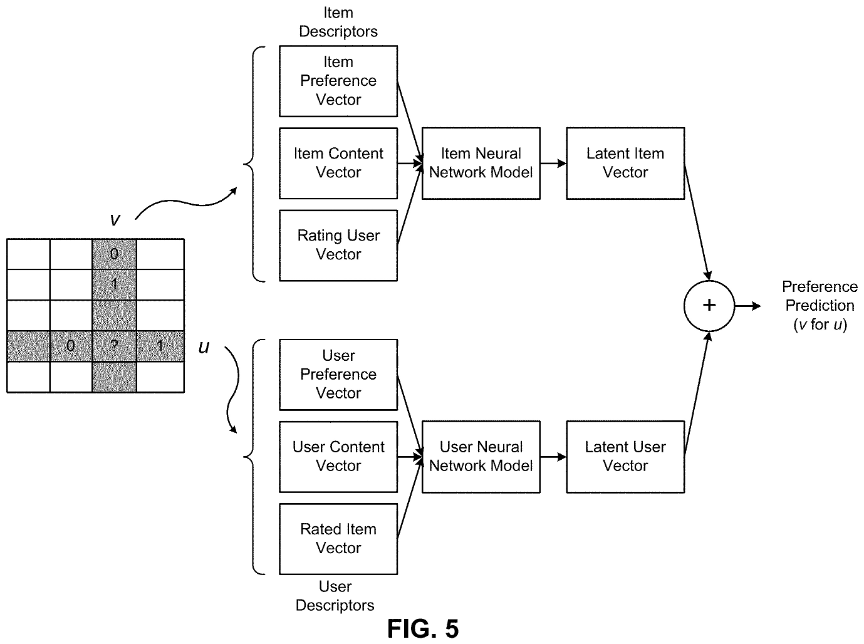
Source: FIG. 5, U.S. Pub. No. 2021/0027160 A1 (TD Bank)
So what sank it?
The specification described the application, not the improvement. The Board quoted the applicant’s own words back, “[t]he recommendation system applies one or more neural networks to the item descriptors and user descriptors,” and concluded “by its own description, Appellant’s system merely applies machine learning … to a new data environment.”¹³
The claims did not conform to the Desjardins formula: Neither the specification nor the claims sufficiently highlighted the improvement in how neural networks operated. “[W]e discern nothing in Appellant’s Specification that indicates that the neural networks operate in an unconventional manner, and the purported improvement is the data that is processed by the respective neural networks,” and “[t]he key factor in Desjardins was that the Specification identified [improvements] in the training of a machine learning model itself, and that those improvements were reflected in the claim.”¹⁴
Appellant leaned on the absence of a prior art rejection. It is the argument every frustrated patent practitioner wants to make: it must be unconventional if the examiner could not find any prior art. Novelty is not eligibility, and Federal Circuit law gives the USPTO a strong out on this point: “patent law does not protect such claims [directed to an advance in the realm of abstract ideas], without more, no matter how groundbreaking the advance.”¹⁵
The isolated variable
With technology, forum, Technology Center, decision date, and procedural posture held roughly constant, the invention story the patent applicant told years prior made the critical difference. Whereas Chen leaned heavily on an improvement to the model, Volkovs only showed an improvement in the underlying data.¹⁶ It can be tempting to think of patent drafting as a relatively dry endeavor, but narrative matters. A problem statement highlighting one or more significant obstacles with a description showing technical detail demonstrating how the inventors overcame those barriers can carry the day in an application that otherwise would not be allowed.
And while “tell a better or different story” may seem overly reductive, I am sure some of my fellow patent practitioners will recall examples when a colleague struggled to overcome a rejection in an application that was simply too dry to convey how important the technology had become to their client.
While there may be opportunities to salvage a dry specification with declaration evidence,¹⁷ your application will be even stronger if the decisionmaker (whether it be the Board or a court) can look to the specification directly, and you will of course avoid thorny issues that could arise under § 112 if you attempt to add a fix only appearing in your declaration into your claims.¹⁸
The drafting and prosecution checklist
Drafting
☐ Include a paragraph in your specification that names the technical deficiency or the problem in the prior approach (e.g., a prior model). Do not overly focus on the business or economic problem. In the context of model training, for example, you could highlight issues with latency, memory, stability, catastrophic forgetting, data efficiency, accuracy under distribution shift, etc.
☐ Write the corresponding paragraph explaining in technical terms how the claimed technique addresses the problem.
☐ Ensure your independent claims recite the “fix” — a technical benefit appearing in the specification is not enough at MPEP Step 2A, Prong 2. E.g., Constellation Designs, LLC v. LG Elecs. Inc., No. 2024-1822, slip op. at 20 (Fed. Cir. Aug. 31, 2026) (“the specification cannot be used to import details from the specification if those details are not claimed”).
☐ Audit your specification for language directed to “generic AI” or algorithmic approaches. Some examples may include “applies one or more neural networks,” “leverages machine learning,” or “uses a trained model to.” Although it is tempting to write the specification as broadly as possible, you must avoid untethering the description from the fix.
Prosecution
☐ Explicitly refer to the technical improvement and relate the claim language reciting it back to the relevant portion of the specification. Draw the distinction between Desjardins and Recentive. For extra credit, footnote the difference between Ex parte Chen and Ex parte Volkovs, distinguishing between an application where the specification describes a technical problem in the model and a solution that is incorporated into the claim and one where it is not.
☐ Do not lead with “there is no prior-art rejection.” The Examiner and the Board have an easy rebuttal with SAP v. InvestPic.¹⁹
☐ If you need to bolster your § 101 arguments, consider a Rule 132 subject matter eligibility declaration (SMED) to augment the technological improvement evidence in the record.²⁰
If you made it this far, I owe you a beer.
Grab one with me in Washington, DC.
Author Note
Stephen G. Nagy is a patent attorney and engineer at Strain PLLC. This article is for general informational and educational purposes only, is not legal advice, and does not create an attorney-client relationship. It reflects the author’s views, not necessarily those of Strain PLLC. Legal authorities change; verify currency before relying on anything here. For advice on your specific situation, consult qualified counsel.
This article is my own work:
Notes
1. Ex parte Desjardins, Appeal No. 2024-000567 (PTAB Sept. 26, 2025) (Appeals Review Panel) (designated precedential Nov. 4, 2025), https://www.uspto.gov/sites/default/files/documents/202400567-arp-rehearing-decision-20250926.pdf. The panel was Director John A. Squires, Acting Commissioner for Patents Valencia Martin Wallace, and Vice Chief Administrative Patent Judge Michael W. Kim. Id. at 1.
2. Briefly, the “2019 Revised Patent Subject Matter Eligibility Guidance” directs the patent office to first consider whether the claim recites: 1) any judicial exceptions, including certain groupings of abstract ideas (i.e., mathematical concepts, certain methods of organizing human activity such as a fundamental economic practice, or mental processes) (Alice “Step One,” referred to as MPEP Step 2A, prong 1); and 2) additional elements that integrate the judicial exception into a practical application (Alice “Step One,” referred to as MPEP Step 2A, prong 2). If a claim recites (1) and does not recite (2), then the patent office moves to Step 2B (Alice “Step Two”), to assess whether the claim: 3) adds a specific limitation beyond the judicial exception that is not “well-understood, routine, conventional” in the field; or 4) simply appends well-understood, routine, conventional activities previously known to the industry, specified at a high level of generality, to the judicial exception. See Ex parte Volkovs, Appeal No. 2026-001638, slip op. at 5–6 (PTAB Aug. 31, 2026) (summarizing the Guidance, 84 Fed. Reg. at 52); MPEP § 2106.
3. 1. A computer-implemented method of training a machine learning model, wherein the machine learning model has at least a plurality of parameters and has been trained on a first machine learning task using first training data to determine first values of the plurality of parameters of the machine learning model, and wherein the method comprises: determining, for each of the plurality of parameters, a respective measure of an importance of the parameter to the first machine learning task, comprising: computing, based on the first values of the plurality of parameters determined by training the machine learning model on the first machine learning task, an approximation of a posterior distribution over possible values of the plurality of parameters, assigning, using the approximation, a value to each of the plurality of parameters, the value being the respective measure of the importance of the parameter to the first machine learning task and approximating a probability that the first value of the parameter after the training on the first machine learning task is a correct value of the parameter given the first training data used to train the machine learning model on the first machine learning task; obtaining second training data for training the machine learning model on a second, different machine learning task; and training the machine learning model on the second machine learning task by training the machine learning model on the second training data to adjust the first values of the plurality of parameters to optimize performance of the machine learning model on the second machine learning task while protecting performance of the machine learning model on the first machine learning task, wherein adjusting the first values of the plurality of parameters comprises adjusting the first values of the plurality of parameters to optimize an objective function that depends in part on a penalty term that is based on the determined measures of importance of the plurality of parameters to the first machine learning task.
4. Desjardins, slip op. at 9 (“When evaluating the claim as a whole, we discern at least the following limitation of independent claim 1 that reflects the improvement: ‘adjust the first values of the plurality of parameters to optimize performance of the machine learning model on the second machine learning task while protecting performance of the machine learning model on the first machine learning task.’”); see also id. at 6–7 (analyzing the claims under “Alice Step One; MPEP Step 2A, Prong Two”).
5. Recentive, 134 F.4th at 1212–13 (“Even if Recentive had not conceded the lack of a technological improvement, neither the claims nor the specifications describe how such an improvement was accomplished. That is, the claims do not delineate steps through which the machine learning technology achieves an improvement.”).
6. Claim 1 of the ’811 patent recites: A computer-implemented method for dynamically generating a network map, the method comprising: receiving a schedule for a first plurality of live events scheduled to start at a first time and a second plurality of live events scheduled to start at a second time; generating, based on the schedule, a network map mapping the first plurality of live events and the second plurality of live events to a plurality of television stations for a plurality of cities, wherein each station from the plurality of stations corresponds to a respective city from the plurality of cities, wherein the network map identifies for each station (i) a first live event from the first plurality of live events that will be displayed at the first time, and (ii) a second live event from the second plurality of live events that will be displayed at the second time, and wherein generating the network map comprises using a machine learning technique to optimize an overall television rating across the first plurality of live events and the second plurality of live events; automatically updating the network map on demand and in real time based on a change to at least one of (i) the schedule and (ii) underlying criteria; wherein updating the network map comprises updating the mapping of the first plurality of live events and the second plurality of live events to the plurality of television stations; and using the network map to determine for each station (i) the first live event from the first plurality of live events that will be displayed at the first time and (ii) the second live event from the second plurality of live events that will be displayed at the second time.
7. Id. at 1212–13.
8. 1. A computer-implemented method, comprising: training, by a device operatively coupled to a processor, using a set of audio recordings of users, a neural network personality model, to determine personality traits of the users; generating, by the device, text-speech hybrid data associated with a user, wherein the generating comprises: converting, using a machine learning model, an audio recording comprising verbal input of the user into voice data comprising: tone data comprising linguistic characteristics of intonations of a voice of the user in the verbal input of the user, and text data representative of words extracted from the verbal input of the user, wherein the text data is augmented with psycholinguistic data; determining, using the machine learning model, a reliability of the tone data for predicting at least one personality trait of the user; determining, using the machine learning model, based on the reliability of the tone data, a first weight to apply to the tone data; and determining, using the machine learning model, based on the reliability of the tone data, a second weight to apply to text data; selecting a first subset of the tone data, wherein an amount of the tone data included in the first subset is based on the first weight; selecting a second subset of the text data, wherein an amount of the text data included in the second subset is based on the second weight; and combining the first subset of the tone data with the second subset of the text data to generate the text-speech hybrid data; and retraining, by the device, using the text-speech hybrid data, the neural network personality model to determine the at least one personality trait of the user.
9. Ex parte Chen, Appeal No. 2026-001932, slip op. at 5–6 (PTAB Aug. 31, 2026) (nonprecedential) (citing Spec. ¶ 29).
10. Id. at 6. The Board’s opinion spells the case name “Desjardines”; the spelling is corrected here.
11. U.S. Provisional Patent Application No. 62/387,493 (filed Dec. 23, 2015), to which Application No. 17/036,900 claims priority through Application No. 15/389,315 (now U.S. Patent No. 10,824,941); Press Release, Amazon, Amazon Echo Now Available to All Customers (June 23, 2015), https://press.aboutamazon.com/2015/6/amazon-echo-now-available-to-all-customers.
12. Non-Final Rejection at 14–15, U.S. Patent Application No. 17/036,900 (June 15, 2023) (“Independent claims 1 and 13 and their respective dependent claims . . . would be considered allowable over the prior art assuming that any 101 and double patenting issues were dealt with.”); Final Rejection at 10, U.S. Patent Application No. 17/036,900 (Nov. 30, 2023) (same). The first action also entered a nonstatutory double-patenting rejection over TD’s own parent, U.S. Patent No. 10,824,941; the later actions entered only § 101 and § 112(b) rejections.
13. Ex parte Volkovs, Appeal No. 2026-001638, slip op. at 13 (PTAB Aug. 31, 2026) (nonprecedential) (quoting Spec. ¶ 10).
14. Id. at 12–14.
15. SAP Am., Inc. v. InvestPic, LLC, 898 F.3d 1161, 1170 (Fed. Cir. 2018); see Volkovs, slip op. at 15 (quoting SAP, 898 F.3d at 1170, in response to Appellant’s reliance on “the lack of prior art rejection”).
16. Volkovs, slip op. at 13–14.
17. Memorandum from John A. Squires, Under Sec’y of Com. for Intell. Prop. & Dir., U.S. Pat. & Trademark Off., to All Patent Applicants and Patent Practitioners, Best Practices for Submission of Rule 132 Subject Matter Eligibility Declarations (SMEDs) (Apr. 30, 2026) (superseding the Dec. 4, 2025 memorandum), https://www.uspto.gov/sites/default/files/documents/smeds-application-practitioners-4302026.pdf.
18. MPEP § 2163.
19. SAP, 898 F.3d at 1170; Volkovs, slip op. at 15.
20. Memorandum from John A. Squires, Under Sec’y of Com. for Intell. Prop. & Dir., U.S. Pat. & Trademark Off., to All Patent Applicants and Patent Practitioners, Best Practices for Submission of Rule 132 Subject Matter Eligibility Declarations (SMEDs) (Apr. 30, 2026) (superseding the Dec. 4, 2025 memorandum), https://www.uspto.gov/sites/default/files/documents/smeds-application-practitioners-4302026.pdf.