What Goes in the Patent, and What Stays in the Building
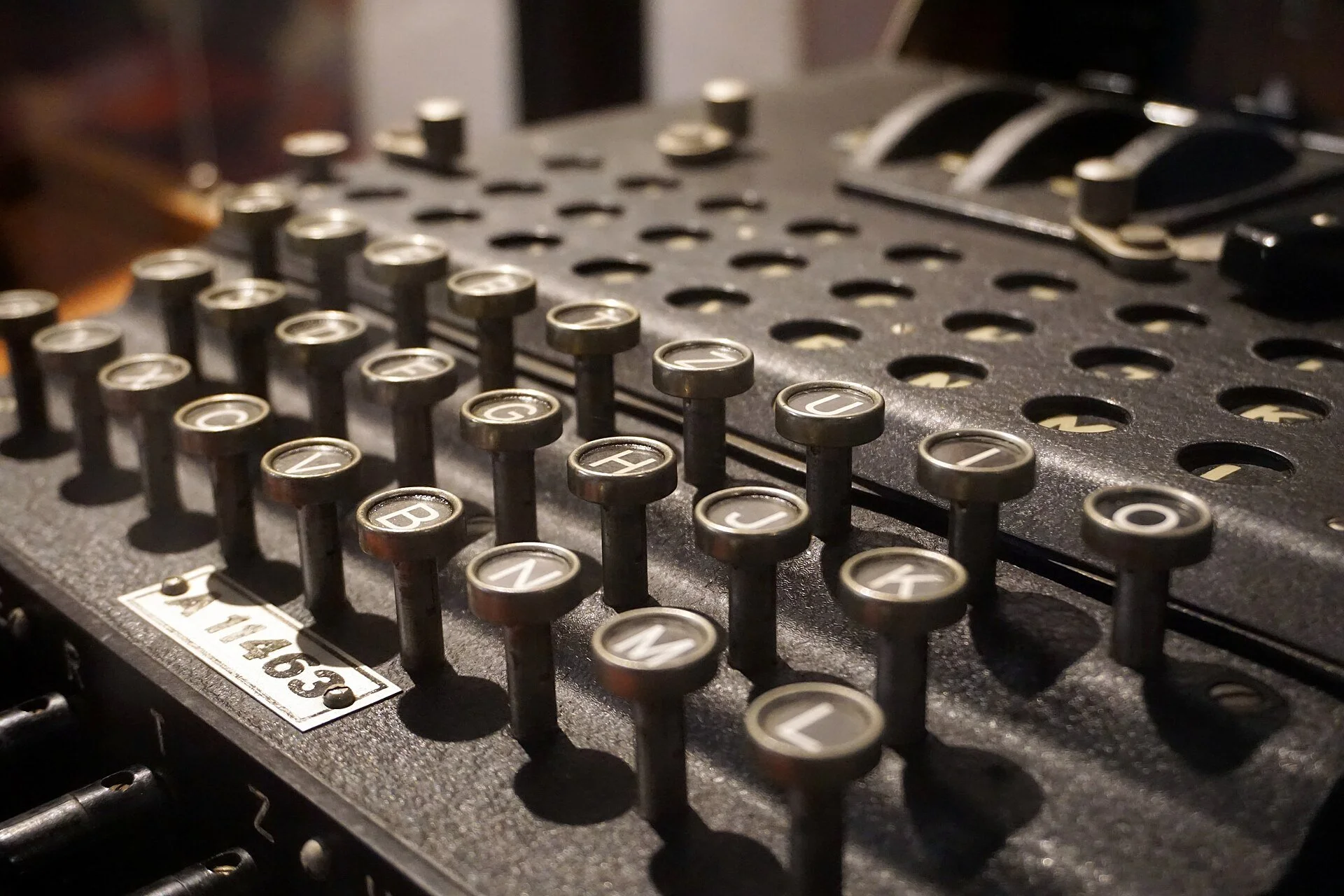
The Enigma Machine, famously used by Germany to transmit secrets during WW2. Copyright information here.
This post was originally published on Substack. If you would like to receive email alerts for new posts, I encourage you to visit and subscribe: https://open.substack.com/pub/stnagy/p/what-goes-in-the-patent-and-what?r=5co1ve&utm_campaign=post&utm_medium=web&showWelcomeOnShare=true
Inventors, founders, and in-house counsel face a recurring question whenever their company develops new technology: what goes into the patent application, and what stays inside the building.
That question has taken on a new edge lately. The instinct behind the pro-secrecy argument shows up constantly in that setting: if we patent this, we’re teaching our competitors how to build it. Increasingly, that instinct is being voiced not just by cautious in-house counsel, but by prominent founders themselves.
In a recent Hoover Institution interview, Anduril founder Palmer Luckey argued that patents have become “Chinese instruction manuals,” that America should “stop patenting everything,” and that we should instead classify far more inventions to keep them from our adversaries. Luckey’s words echo those of Elon Musk, who in 2012 complained that if SpaceX published patents, “the Chinese would just use them as a recipe book.”
The concern behind these claims is shared across the aisle. Recent Republican and Democratic administrations have labeled research theft and IP misappropriation by foreign adversaries (especially China) a critical security concern:
Trump Administration: “China’s theft of American technology, intellectual property, and research threatens the safety, security, and economy of the United States.”
Biden Administration: “The research security challenges we face are real and serious: some foreign governments, including China’s government, are working hard to illicitly acquire our most advanced technologies. This is unacceptable.”
And this is not the first time the United States has contemplated solutions to foreign IP theft.
During the Second World War, the United States classified the work of its own inventors to prevent it from falling into Nazi hands. Under the evocatively named “Act of July 1, 1940,” more than eleven thousand patent applications relating to radar, cryptography, synthetic materials, and other advanced technologies were ordered secret, their inventors barred from publishing, selling, or filing abroad.
As an obfuscation measure, it worked. The technology largely stayed out of public view until the war ended, not only in Germany, but worldwide. Economic research published within the past decade shows substantially reduced diffusion of ideas for classified technologies, dampening the follow-on work those patents would otherwise have seeded until the restrictions were lifted. That history is worth remembering right now, as renewed calls for invention secrecy gain traction.
But history also offers a warning about the limits of that strategy. The expansionist secrecy argument, taken at face value, elides some of the tradeoffs that made WWII-era secrecy a costly and imperfect tool even when it worked.
In the sections that follow, I’ll examine an expansionist patent secrecy argument in more detail, where it holds up and where it doesn’t, and lay out a practical framework for how inventors, founders, and counsel can actually decide, invention by invention, what belongs in a patent application and what belongs in a trade secret policy instead.
The Invention Secrecy Act
Modern defense technology is built largely by private American companies, and a patent application is a public document. If a company builds military technology and patents it, they may hand a detailed technical description to anyone who cares to read it, including foreign governments that would like to build the same thing and feel no obligation to license it. After all, a United States patent only has force inside the United States.
Luckey’s suggestion is to keep more technology out of public view, by expanding the use of “classified patents” so an inventor can protect an invention without publishing it.
Under the Invention Secrecy Act, codified at 35 U.S.C. §§ 181-188, an agency head or the Commissioner of Patents can order an invention kept secret whenever publication or the grant of a patent “might … be detrimental to the national security.” An order runs for one year and is renewable annually; one issued in wartime lasts for the duration of hostilities and a year beyond. So Luckey is not proposing a new tool. He is proposing to expand an old one by using it far more often.
It is also worth being precise about what a secrecy order does, because his description is a little generous. Luckey says you can “get a patent on something that you are not allowed to disclose to anyone, but you still maintain the exclusivity on those rights.” Not quite. Section 181 does not hand you a secret patent, it withholds your patent until the order is lifted. The application sits, and the grant does not issue while the order is in force. Companies do not hold a secret monopoly enforceable against anyone.
More than 6,500 secrecy orders were in effect at the end of the government’s 2025 fiscal year, but new orders on private inventors have averaged only about fifteen per year over the past five years. For context, the USPTO receives more than 600,000 applications per year (as it has for more than a decade). As applied to the public sector, these orders are a de minimis burden but are virtually non-existent in the private sector. “Massively expanding” the program would functionally create a new rule in both domains.
Expanding secrecy involves tradeoffs. Patent practitioners will be familiar with the idea a patent is an exchange between the inventor and the public:
The inventor provides a disclosure. Section 112 requires the specification to describe the invention and to teach how to make and use it in terms clear enough that someone skilled in the field could do so, and to set out the best way (best mode) the inventor knows to carry it out.
In return, the public provides a time-limited right to exclude. Section 154 gives the patentee the right to stop others from making, using, selling, offering to sell, or importing the claimed invention in the United States, running twenty years from the filing date. Then the patent expires, and the invention belongs to everyone.
The Supreme Court has consistently described this as a bargain rather than a favor. In Kewanee Oil, holding that state trade secret law survives alongside the federal patent system, the Court treated disclosure as what the public receives in exchange for the monopoly. In Bonito Boats, the Court struck down a state statute that offered patent-like protection without the federal system’s disclosure requirements as a trade the states were not free to quietly rewrite. And most recently, in Amgen v. Sanofi, the Court enforced the inventor’s side with real rigor: claim a broad genus and you must enable its full scope. The more you claim, the more you must teach.
That is the yardstick for everything that follows. What Luckey is proposing is one half of the trade without the other. Or in other words, protection for the inventor without the record the public was supposed to receive in return.
(And as we’ve seen above, a secrecy order withholds the grant too, so while it runs, neither side of the bargain is performed.)
The Necessity of a Coherent Patent and Trade Secret Policy
For a patent to be an “instruction manual,” it would need to hand the reader a working recipe, downloadable and ready to build. But for structural reasons, that is not how well-drafted patent disclosures work.
Section 112 of the Patent Act requires the inventor to enable the claimed invention for “a person skilled in the art.” That is a real obligation, and, as Amgen shows, courts will enforce it. But the devil is in the details.
The inventor must teach the invention claimed, usually based on a prototype; not the commercial product, and certainly not the tolerances, the process window, the supplier list, the yield tricks, the thousand adjustments that separate that prototype from its final sellable form. The commercially critical know how should not be in the patent. It stays where sophisticated companies keep it: as trade secrets that never expire, running alongside the patent rather than inside it.
And under modern patent law in the United States, there is almost no practical drawback to overprotecting critical process information that would help a competitor make your commercial product. Section 112 still technically requires applicants to disclose the “best mode” of carrying out the invention, but the America Invents Act pulled out the enforcement mechanism. An applicant can satisfy § 112 while keeping the crown jewels off the page, and, at the margin, has every incentive to.
The result is that patents often are not instruction manuals. For example:
ASML, the sole producer of the extreme-ultraviolet (EUV) lithography machines behind the world’s most advanced semiconductors, has thousands of patents and published applications worldwide, yet no other company, Chinese or otherwise, has been able to build competing EUV equipment. A similar story plays out in other semiconductor contexts: TSMC, Nvidia, etc. file thousands of applications, but competitors haven’t caught up.
Pratt & Whitney patented directional-solidification and single-crystal casting starting in the 1960s, and the core science has been public for decades. The core intellectual property is not the base material formula or the science of single-crystal manufacturing itself, it is process control. Dozens of variables must be held within very small tolerances during the casting process, and yield is the central difficulty. China has made real progress (its AECC institute claims an independently developed DD6 single-crystal superalloy), but it took decades of accumulated foundry experience to get there rather than reading the patent literature.
It is extremely difficult, if not impossible, to generate a biosimilar without a precise re-creation of the manufacturing process and cell line used to produce the reference biologic. Because the originator’s manufacturing process is proprietary, the biosimilar developer must extensively analyze the originator and use reverse engineering rather than working from the patent disclosure. Small-molecule generics can typically replicate the innovator on the strength of the expired patent alone; biologics can’t, because the cell-line/fermentation/purification know-how was never fully captured in the patent claims.
An adversary who reads a patent might set a goalpost to aim at, but building a product is much more complicated than ingesting a patent disclosure when the patent holder takes a sophisticated approach to patents and trade secrets.
The Scholarly Literature Shows the Impact of Secrecy
A well-known line of legal scholarship argues that patents are poor teaching documents: that most of what they contain is available elsewhere, and that American firms are actively discouraged from reading competitors’ patents at all. Knowing about a patent is a predicate for willful infringement, opening the door to enhanced damages of up to three times the award under § 284. Although the law has shifted to some degree in the past decade, the practical advice to clients has been stable: employees should not browse a competitor’s patent portfolio.
But a newer line finds value in patent disclosure. Daniel Gross’s study of the WWII secrecy program (the same one referred to above) found that inventions kept secret longer drew measurably fewer follow-on citations, meaning others built on them less. Furman and coauthors found that expanding access to patent collections increased local follow-on invention. Hegde and coauthors found that publishing applications earlier helped. Gross names Roin, Fromer, and Devlin directly and pushes back.
So are patents instruction manuals, or aren’t they?
The patent disclosure has at least some real value, but the patent itself is rarely the channel through which a determined foreign adversary acquires American technology, at least in 2026.
The effect in Gross comes from a program that suppressed everything, inventors could not publish, file abroad, or sell the product, so it measures the cost of total secrecy, not the teaching power of the patent document standing alone. Although this kind of secrecy could be effective in 2026, this is a much stronger remedy compared to what Luckey, Musk, and others are calling for.
Gross himself also notes contemporaneous government studies concluding patents were not, by themselves, a major source of technical information. And his setting is domestic diffusion in the 1940s, not a modern state adversary with cyber operations and a recruiting budget operating in a society where American workers have much greater mobility.
Setting aside the debate over how effective patent disclosures are at transferring knowledge, secrecy also has measurable costs.
Gross’s work examined the impact on classification and secrecy for technologies that mattered to the war (radar, cryptography, synthetic materials), under an order that rescinded protection in late 1945, causing their release almost all at once. The abrupt ending created a useful experiment: inventions that entered the program early (e.g., in 1940) sat under seal for years; those that entered late (e.g., in early 1945) sat for months. The difference in duration is essentially arbitrary, allowing Gross to isolate what the secrecy itself did.
As previewed above, the program largely worked. Gross tracked distinctive terms that first appeared in wartime patents and looked for them across the broader published record. Words that debuted in secret patents stayed out of public discourse until the war ended, then jumped into it permanently.
But secrecy also slowed American progress. Among the secret patents, those classified longer were cited less: a patent filed in 1945, which sat under seal only briefly, was more likely to be cited than one filed in 1940. Fewer citations meant less follow-on work. The effect reached the market, as well. Gross traced new chemical terms into DuPont’s product catalogs and found inventions under secrecy arrived later than comparable ones, even after the order was lifted, a lag that only closed around 1949.
That wartime program was about as favorable a case for invention secrecy as anyone could construct. It was narrow, aimed at technology with direct war relevance. It was administered by officials who, by contemporaneous accounts, tried not to issue orders without compelling reason. It was temporary, and, from a historical perspective, it ended quickly. Yet it still imposed measurable costs on American innovation and commercialization.
A broader patent secrecy policy also implicates First Amendment and prior restraint concerns that have yet to be tested in the patent secrecy domain, which are beyond the scope of this article.
Thus, expanding classified patents risks spending the patent system’s core benefits, exclusion and public notice, to close a channel the evidence suggests is minor, while possibly slowing domestic innovation, and extending a constitutionally untested regime across a population of inventors it currently does not touch.
Patent vs. Trade Secret
The question in the title is not really a Washington question. If you run a company building something valuable, you answer a small version of Luckey’s question every time you draft a patent application: what goes into the disclosure, and what stays inside the building?
At both the national policy scale and the narrow company scale, the question deserves a more thoughtful and precise answer, with consideration for the strengths and weaknesses of each tool.
A patent gives you the right to exclude, a legally powerful barrier to entry, and one that holds even against a competitor who developed the same thing independently. A trade secret, kept truly secret, can be a more powerful barrier still: it never expires, and it teaches nothing to anyone. But it is also the more fragile of the two. It protects against theft and broken confidence, not against reverse engineering or independent invention. Patents and trade secrets are not substitutes. They protect different layers, confer different private and public benefits, and exact different costs.
Which is, in the end, the problem with the classified patent: it merges the two into a single unified right. Exclusivity without disclosure; secrecy without fragility. The inventor gets the best of both barriers, and the public gets the benefit of neither; no teaching, and no competition. The better answer is not to fuse the two tools but to hold both, each doing the job it was built for: the patent on what shows, the secret on what stays in the building.
If you’re weighing what to protect and how, that is a conversation worth having with a capable attorney before you file or publish. Below is a rough sorting rule when considering how to tackle your company’s intellectual property strategy, but it is just a starting point. Please seek out sophisticated counsel.
A rough sorting rule:
Patent it if it is visible in or reverse-engineerable from the product, if you will need to license or enforce it, if investors will ask about it, or if a competitor could plausibly get there independently.
Keep it secret if the value lives in know-how that never leaves your facility, like process parameters, manufacturing technique, internal tooling, or if it genuinely can’t be read off the product, and if you have the operational discipline to actually protect it.
Usually, do both, on different layers of the same technology.
Author Note
Stephen G. Nagy is a patent attorney and engineer at Strain PLLC. This article is for general informational and educational purposes only, is not legal advice, and does not create an attorney-client relationship. It reflects the author’s views, not necessarily those of Strain PLLC. Legal authorities change; verify currency before relying on anything here. For advice on your specific situation, consult qualified counsel.
Footnotes
Uncommon Knowledge with Peter Robinson: Palmer Luckey Wants America to Win, Hoover Institution (recorded May 7, 2026), https://www.hoover.org/research/palmer-luckey-wants-america-win.
Chris Anderson, Elon Musk’s Mission to Mars, Wired (Oct. 21, 2012), https://www.wired.com/2012/10/ff-elon-musk-qa/ (“We have essentially no patents in SpaceX. Our primary long-term competition is in China—if we published patents, it would be farcical, because the Chinese would just use them as a recipe book.”).
Press Release, White House, President Donald J. Trump Is Protecting America From China’s Efforts To Steal Technology And Intellectual Property (May 29, 2020), https://trumpwhitehouse.archives.gov/briefings-statements/president-donald-j-trump-protecting-america-chinas-efforts-steal-technology-intellectual-property/.
Dr. Eric Lander, Director of the White House Office of Science and Technology Policy, Foreword to the Guidance for Implementing NSPM-33 on National Security Strategy for U.S. Government-Supported R&D (Jan. 2022).
Act of July 1, 1940, ch. 501, 54 Stat. 710 (Pub. L. No. 76-700).
Daniel P. Gross, The Hidden Costs of Securing Innovation: The Manifold Impacts of Compulsory Invention Secrecy, 69 Mgmt. Sci. 2318 (2023) (studying the more than 11,000 applications placed under secrecy orders in World War II; earlier version circulated as NBER Working Paper No. 25545).
Section 183 lets an owner whose patent is withheld seek compensation for the damage the secrecy order caused and for the government’s use of the invention, either by agreement with the agency that requested the order or by suit in the Court of Federal Claims, or in the federal district court where the claimant resides. 35 U.S.C. § 183. But the record on how well that works is not encouraging: a 1980 House committee study of the government’s classification of private inventions concluded that an inventor’s statutory right to just compensation for secrecy-order damages “appears more illusory than real.” H.R. Rep. No. 96-1540 (1980).
Invention Secrecy Statistics, Federation of American Scientists, https://sgp.fas.org/othergov/invention/stats.html (6,543 secrecy orders in effect at the close of FY2025).
Id. New “John Doe” secrecy orders imposed on private inventors numbered 29, 1, 25, 0, and 18 in FY2021 through FY2025 — an average of about fifteen per year, with large year-to-year variance.
U.S. Patent Statistics Summary Table, Calendar Years 1963–2020, USPTO, https://www.uspto.gov/web/offices/ac/ido/oeip/taf/us_stat.htm (total applications exceeded 600,000 in every calendar year from 2013 through 2020, the most recent year tabulated).
Kewanee Oil Co. v. Bicron Corp., 416 U.S. 470, 484 (1974) (disclosure is “the quid pro quo of the right to exclude”).
Bonito Boats, Inc. v. Thunder Craft Boats, Inc., 489 U.S. 141, 150–51 (1989).
Amgen Inc. v. Sanofi, 598 U.S. 594, 604–16 (2023).
35 U.S.C. § 282(b)(3)(A) (failure to disclose the best mode “shall not be a basis on which any claim of a patent may be canceled or held invalid or otherwise unenforceable”).
Lumenci, ASML Patent Portfolio Analysis (Nov. 14, 2025), https://lumenci.com/patent-portfolio/asml/ (reporting 8,123 U.S. patent documents in a worldwide portfolio of 38,106).
Barry Miller, Each Blade a Single Crystal, Am. Scientist (Apr. 30, 2018), https://www.americanscientist.org/article/each-blade-a-single-crystal (reporting that Frank VerSnyder’s directionally-solidified columnar-grain turbine blade — the precursor to the single-crystal blade — was patented for Pratt & Whitney in 1966).
Erika Lietzan et al., Paucity of Intellectual Property Rights Information in the US Biologics System a Decade After Passage of the Biosimilars Act, PMC (2024), https://pmc.ncbi.nlm.nih.gov/articles/PMC11081489/ (citing the underlying source at their note [32] for this proposition).
Benjamin N. Roin, Note, The Disclosure Function of the Patent System (or Lack Thereof), 118 Harv. L. Rev. 2007 (2005); Jeanne C. Fromer, Patent Disclosure, 94 Iowa L. Rev. 539 (2009); Alan Devlin, The Misunderstood Function of Disclosure in Patent Law, 23 Harv. J.L. & Tech. 401 (2010).
35 U.S.C. § 284; see Halo Elecs., Inc. v. Pulse Elecs., Inc., 579 U.S. 93 (2016) (discarding the Federal Circuit’s rigid Seagate test; enhanced damages remain discretionary and are reserved for egregious infringement).
Gross, supra note 6.
Jeffrey L. Furman, Markus Nagler & Martin Watzinger, Disclosure and Subsequent Innovation: Evidence from the Patent Depository Library Program, 13 Am. Econ. J.: Econ. Pol’y 239 (2021) (local patenting rose 8–20% after a patent library opened nearby).
Deepak Hegde, Kyle Herkenhoff & Chenqi Zhu, Patent Publication and Innovation, 131 J. Pol. Econ. 1845 (2023) (faster publication of applications sped up and increased follow-on citations and reduced duplicative R&D).
Gross, supra note 6.
Gross, supra note 6.
See N.Y. Times Co. v. United States, 403 U.S. 713 (1971) (per curiam); cf. Halpern v. United States, 258 F.2d 36 (2d Cir. 1958) (suit for secrecy-order compensation; addressing trial in camera of a claim still under secrecy).