An AI agent found your lead, who owns the patent?
Your agentic AI model ran overnight, and when your engineers returned the following they, they found exactly what you needed: a short list of candidates, ranked by predicted activity, ready to investigate, develop, and (hopefully) commercialize. The engineers who wrote and keyed in the prompt drew up an invention disclosure and completed the inventorship box with their own names. The patent application was drafted and filed. Assignments were executed and recorded, and your company will soon own a valuable patent.
Or will it?
If your patent includes a “vibe invention,” it may be at risk. The term borrows from “vibe coding,” a now-familiar software development practice in which a developer steers an AI system through high-level prompts, minimal specifications, and little to no manual code editing, relying on the model to fill in architecture, resolve errors, and iterate toward a working result.
Claude Code is a popular vibe coding tool produced by Anthropic.
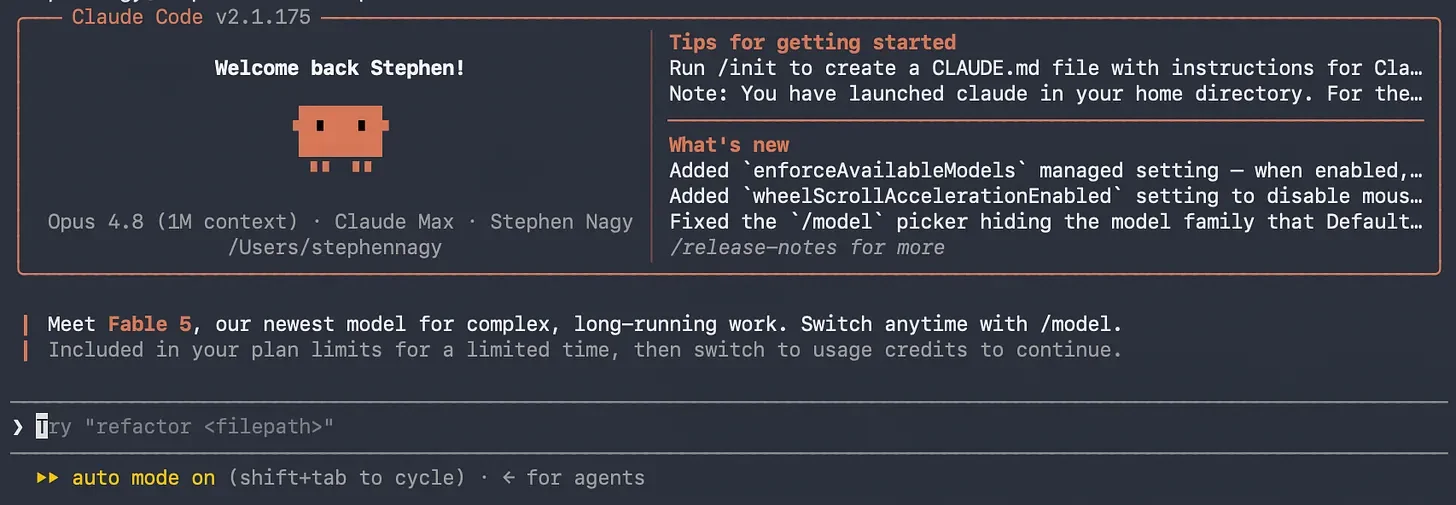
Claude Code is a popular vibe coding tool produced by Anthropic.
The same dynamic has migrated beyond software: scientists and engineers increasingly direct powerful AI agents through high-level prompts, rely on those agents to execute substantive and often innovative work, and produce results that are then claimed as patentable inventions.[1]
But an uncomfortable cloud hangs over agentic inventions, and even those who own their own tools (as opposed to using vendors) are exposed.
Relatively cheap agentic AI (at least compared to bespoke implementations) is now readily available, meaning vibe invention is now arguably broadly unlocked. As an example, Anthropic’s recently-released[2] Claude Mythos 5 and Claude Fable 5 models include a combined system card reporting these models “can likely accelerate well-resourced expert teams at novel bioweapon development, and materially increase their chances of success,” approaching its “CB-2 capabilities” designation for the first time.[3] Beyond general‑purpose foundation models, enterprises are deploying domain‑specific LLM‑based and deep‑learning systems tailored to their own data and processes, often developed in collaboration with specialized vendors.[4] Indeed, companies are spending billions in the race towards AI-designed inventions.[5]
These shifts make questions of AI inventorship more relevant than ever.
AI is a tool; it cannot be an inventor
The Patent Act defines an “inventor” as the “individual…who invented or discovered the subject matter of the invention,” but does not define “individual.”[6] Under the Federal Circuit’s decision in Thaler v. Vidal, 43 F.4th 1207 (Fed. Cir. 2022), an inventor must be a natural person, so an AI system (like “DABUS” in Thaler) cannot be listed an inventor on a U.S. patent application.[7]
In other words: there is no “name the AI” option. For a patented invention to be valid, a human must have conceived of something, or there is simply nothing to patent.
But how determine what the human conceived? The Thaler opinion explicitly noted that the patentability of inventions made by human beings with the assistance of AI was not before it and remained an open question,[8] and the USPTO has vacillated as the Biden and Trump administrations considered broader AI-policy:
In 2024, the USPTO determined the human inventor must satisfy the “Pannu” factors, showing that they: (1) contributed significantly to conception, (2) made a contribution not insignificant in quality measured against the full invention, and (3) did more than explain well-known concepts / the state of the art.[9] This approach risked excluding humans who did, in fact, conceive the claimed invention but whose contributions were filtered through or refined by AI tools. For example, a researcher who frames the problem, curates data, constrains model architecture, and selects among AI‑generated candidates could be argued (post hoc) to have “merely appreciated AI output,” failing factor (1) or (2), even though, in reality, conception was human‑driven.
In 2025, following Executive Order 14179,[10] the USPTO explicitly rescinded the 2024 guidance and discontinued reliance on Pannu for the human‑versus‑AI question.[11] The guidance explains that “Pannu factors only apply when determining whether multiple natural persons qualify as joint inventors”[12] and that applying them to AI‑assisted inventions as such was therefore inappropriate.[13] Instead, the USPTO re‑anchors AI‑assisted inventorship in the traditional conception framework: AI is a sophisticated tool; the only question is whether one or more natural persons conceived the claimed subject matter.
The pitfalls of careless AI prompting
Thus, the current rule looks simple: inventorship turns on whether a natural person conceived the claimed subject matter, and the USPTO now treats AI as a sophisticated tool. But the guidance explicitly preserves the examiner’s ability to issue a rejection under 35 U.S.C. §§ 101 and 115 where the record suggests no natural person significantly contributed,[14] and the Federal Circuit has yet to definitively weigh in.
In patent law, conception is “the formation in the mind of the inventor [i.e, the human], of a definite and permanent idea of the complete and operative invention, as it is hereafter to be applied in practice.[15]” Merely recognizing a problem or having a general goal or research plan to pursue does not rise to the level of conception.[16] And reducing an invention to practice alone is not a significant contribution that rises to the level of inventorship.[17] Conception thus occupies the zone between experimental design and the application of results, and that zone is precisely where AI is increasingly operating.
When using an agentic AI, i.e., systems capable of completing complex, multi-step tasks with minimal human instruction, the traditional standard of human conception can become severely strained. At what point does human direction of an AI system shade from “using a tool” into “appreciating the output of an autonomous process”?
Let’s consider three scenarios in drug development:
Inventor A provides molecules: Many cancer drugs work by blocking a protein’s obvious “on-switch,” but cancers can mutate that switch until a drug stops working. Inventor A has a better idea: instead of the on-switch, target a separate, overlooked spot on the protein that doesn’t mutate, and design the molecule to latch onto it permanently rather than just brushing past it. She hands the AI a small group of molecules and prompts the agent to predict anticipated potency and stability. The AI performs the ranking and returns the result.
Inventor B provides insight: Inventor B doesn’t know exactly which molecule she wants, but she noticed something nobody else had: the target protein flexes open a hidden pocket, and a drug that slips into that pocket would shut it down. She gives the AI that insight and lets it design candidate molecules. The agent returns a group of novel molecules, but the idea to go after the hidden pocket is hers.
Inventor C provides prompt: Inventor C types a short, general request: “Find me a safe, effective, pill-form drug that shuts this protein down, and rank the best options.” The AI runs overnight, pours over data, considers multiple strategies, and returns a ranked list of twenty molecules. The team makes the top three, tests them, one works beautifully, and is selected for further development.
A and C are simple and straightforward. Inventor A recognized the problem and conceived both the strategy and the molecules; the AI only ranked what she had already designed. The AI functioned essentially as an assay, a tool doing tool work. A is an inventor under any standard. Inventor C did the reverse. She recognized a problem, but a problem statement and goal-setting, however sophisticated, is not conception.[18] The AI chose the strategy and built the molecules. That her team synthesized and tested the winner changes nothing, because reducing an invention to practice is not inventing it. The molecules in scenario C may have no eligible inventor at all, which, as we have seen, can mean there is simply nothing to patent.
The situation with Inventor B is much more interesting, both because it is the one most real programs resemble and because it has no straightforward answer. B’s insight finding the hidden pocket is real and likely non-obvious, and one would think that it gives her a defensible claim at least to the method. But without any additional inventorship safeguards (more on that in a moment), this kind of “vibe invention” may nevertheless ship with bugs that could doom it under the pressure of litigation.
A broad functional claim, for example, “a method of inhibiting the protein by occupying the pocket”, while strong on the inventorship axis (because it claims nothing more than what B actually conceived), may nevertheless face weakness under § 112. A claim defined by what a compound does rather than by what it is is a functional genus, and a patent must enable its full scope. In less predictable technical areas, B’s claim may rightly be found invalid.[19]
Narrowing the claims to the compounds exhibiting the claimed effect runs into inventorship issues. While claims to “a method of inhibiting the protein comprising administering [the inventive compound]” or “a compound comprising [the inventive compound]” fix the enablement weakness, both claims require B to have conceived the structure. B did not, and the AI cannot be named. Conception “must include every feature of [the] claimed invention.[20]”
How can we ensure inventors participate in conception when using AI systems?
Use a Human / AI / Human sandwich
Documented human involvement must bracket AI at both ends of the inventive process. Before the prompt, establishing that a human defined the problem with sufficient particularity to constitute a specific research target rather than a general aspiration. And after the output, establishing that a human exercised genuine evaluative judgment in selecting, modifying, or refining what the model returned. If the AI is the filling, human conception is the bread, and without the bread, what you have is not a sandwich.
Before the prompt (the bottom slice)
Engineers and scientists should (still!) keep a dated lab notebook (or electronic lab notebook) recording the hypothesis, the mechanism, the target, and the specific solution, so the human idea demonstrably predates any agentic prompting. Treat the objective-and-constraint set as inventive work and record its rationale; conception often lives in the constraints.
Decide and document the tool boundary, i.e., what the AI will be asked to originate versus merely optimize (optimize a human-defined invention vs. design from scratch). The boundary is what places you in scenario A, B, or C.
Log the prompt, the model and version, the parameters, and any reference or training data you select, together with the human reasoning behind each choice. An inventor should be able to articulate how she shaped conception, through the construction of specific prompts and the selection and arrangement of training data.
After the AI answers (the top slice)
Record the selection reasoning, not just the selection itself; why a candidate was chosen, the inventive judgment applied, and what was rejected and why. Choosing for an articulable inventive reason supports conception; taking the top-ranked output probably does not.
Make (and document) a human contribution to the claimed embodiment: modify the structure, design analogs, alter the scaffold, combine outputs, so that a person, not the model, conceived the specific thing you intend to claim.
Keep an AI-versus-human delta, a record of what the model produced set against what the humans changed or added. This mirrors emerging audit-trail control of tracking which content was AI-generated and which was human-approved.
Rebuild your invention disclosure
These habits also belong in the paperwork.
Redesign your invention-disclosure forms to ask how AI was used, what prompts, models, and training data were involved, and how the human shaped or refined the AI output into the final conception.
Make sure your documentation elicits answers to a few critical questions: who framed the technical problem, who evaluated the machine’s output, who selected among the alternatives, and who turned raw output into a concrete inventive concept.
—
A vibe invented patent whose R&D process cannot be reconstructed from contemporaneous records is a patent with a structural vulnerability that will not become apparent until litigation, by which point the inventors may be unreachable, the prompts long deleted, and the claim-by-claim human contribution impossible to reconstruct with credibility.
The prescription is not complicated, but it requires deliberate planning. Companies who build AI discipline into their prosecution workflow now will be better positioned to defend their portfolios when the first wave of AI-inventorship validity challenges arrives. In the author’s opinion, that wave is not hypothetical. It is a matter of when, not whether.
Author Note
Stephen G. Nagy is a patent attorney and engineer at Strain PLLC. The author has developed a model AI invention disclosure form for use in documenting AI-assisted inventive processes. Practitioners are welcome to contact the author at stephen.nagy@strainpllc.com to request a copy.
This article first appeared on my Substack: https://stnagy.substack.com/p/an-ai-agent-found-your-lead-who-owns
Footnotes
[1] Boiko, Daniil A., R. MacKnight & Gabe Gomes, Autonomous Chemical Research with Large Language Models, 624 Nature 84 (2023). Samuel Schmidgall et al., Agent Laboratory: Using LLM Agents as Research Assistants (June 18, 2025) (preprint).
[2] Anthropic, Statement on the US government directive to suspend access to Fable 5 and Mythos 5, https://www.anthropic.com/news/fable-mythos-access (noting the U.S. Government has issued an export control directive to suspend all access to Fable 5 and Mythos 5 by any foreign national, whether inside or outside the United States, including foreign national Anthropic employees).
[3] Anthropic, System Card: Claude Fable 5 & Claude Mythos 5, at 34, https://www-cdn.anthropic.com/d00db56fa754a1b115b6dd7cb2e3c342ee809620.pdf
[4] Raza M, Jahangir Z, Riaz MB, Saeed MJ, Sattar MA. Industrial applications of large language models. Sci Rep. 2025 Apr 21;15(1):13755. doi: 10.1038/s41598-025-98483-1. PMID: 40258923; PMCID: PMC12012124.
[5] Annalee Armstrong, AI Is Changing Pharma’s Bottom Line Now—But Not Through Splashy Drug Discovery, BioSpace (Feb. 11, 2026), https://www.biospace.com/business/ai-is-changing-pharmas-bottom-line-now-but-not-through-splashy-drug-discovery.
[6] 35 U.S.C. § 100(f).
[7] Id. at 1208 (“We, too, conclude that the Patent Act requires an ‘inventor’ to be a natural person and, therefore, affirm.”)
[8] Thaler, 43 F.4th at 1213.
[9] Inventorship Guidance for AI-Assisted Inventions, 89 Fed. Reg. 10,043 (Feb. 13, 2024); U.S. Patent & Trademark Off., Inventorship Guidance for AI-Assisted Inventions (Mar. 5, 2024), https://www.uspto.gov/initiatives/artificial-intelligence/artificial-intelligence-resources.
[10] Exec. Order No. 14,179, Removing Barriers to American Leadership in Artificial Intelligence, 90 Fed. Reg. 8,741 (Jan. 31, 2025).
[11] Revised Inventorship Guidance for AI-Assisted Inventions, 90 Fed. Reg. 54,636 (Nov. 28, 2025).
[12] Id. at 54,636.
[13] Id.
[14] 90 Fed. Reg. 54,636-37 (Nov. 28, 2025).
[15] Burroughs Wellcome Co. v. Barr Labs., Inc., 40 F.3d 1223, 1228 (Fed. Cir. 1994) (citing Hybritech Inc. v. Monoclonal Antibodies, Inc., 802 F.2d 1367, 1376 (Fed. Cir. 1986) (quoting 1 Robinson on Patents 532 (1890))).
[16] Burroughs, 40 F.3d at 1228.
[17] Ethicon, Inc. v. U.S. Surgical Corp., 135 F.3d 1456, 1460 (Fed. Cir. 1998) (“One who simply reduces to practice an invention conceived by another is not a joint inventor.”)
[18] Revised Inventorship Guidance for AI-Assisted Inventions, 90 Fed. Reg. 54,636, 54,637 (Nov. 28, 2025) (conception is complete only when the inventor has “a specific, settled idea, a particular solution to the problem at hand, not just a general goal or research plan.”) (quoting Burroughs Wellcome Co. v. Barr Labs., Inc., 40 F.3d 1223, 1228 (Fed. Cir. 1994)).
[19] Amgen Inc. v. Sanofi, 598 U.S. 594, 610-11 (2023) (“If a patent claims an entire class of processes, machines, manufactures, or compositions of matter, the patent’s specification must enable a person skilled in the art to make and use the entire class. . . . The more one claims, the more one must enable.”)
[20] Burroughs, 40 F.3d at 1228.*